Range Repair
No Gas to the Range After a Jolt: Seismic Shutoff Valves and What to Check Before You Open a Viking
If every burner and the oven lost gas at the same moment, check the seismic gas shutoff valve at the meter before anyone opens the range. Plenty of Los Angeles meter sets carry one, it latches closed on motion, and it has to be re-armed by hand.
Written by
Keiko Mabuchi
Service technician — cooktops and ventilation · 11 years in the trade
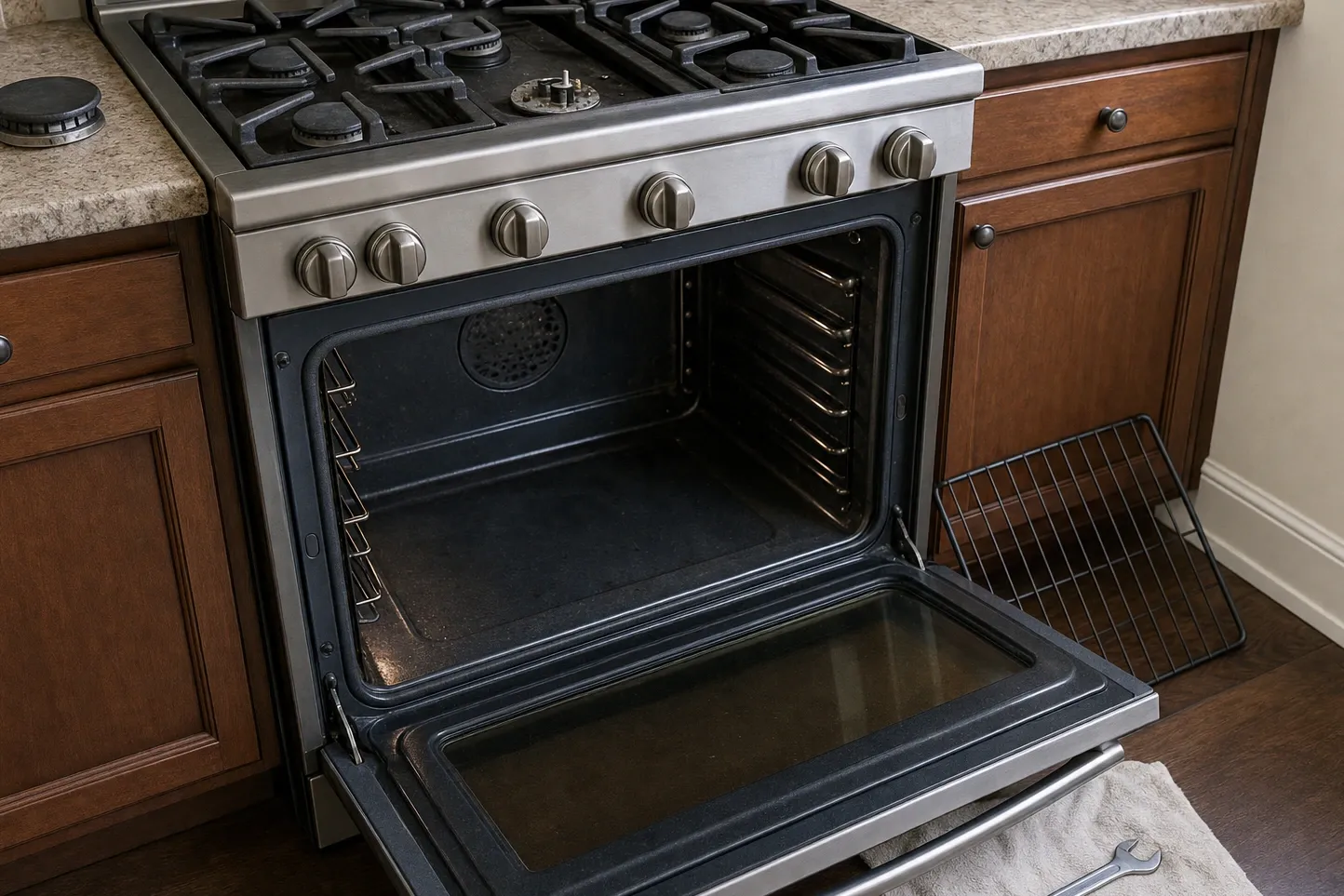
A Viking range that has gone completely dead on gas in Los Angeles is very often not the range. Between the meter and the appliance there may well be a latching valve, and unlike a tripped breaker it is something nobody in the house has ever had to think about.
The call we take most often here
The most common call from this map is not a burner fault at all. It is total, simultaneous loss of gas — every surface burner and the oven together — after a jolt, after work at the meter riser, or occasionally after a large simultaneous demand. That pattern sits upstream of the appliance, at the seismic gas shutoff valve.
Appliance faults are almost never that tidy. A failed gas valve takes out one burner. An ignition fault takes out one location. A control problem usually leaves something still working. When an entire manifold goes quiet at once and nothing inside the appliance was touched, supply is the first suspect — and in this service area the supply now runs through a device most owners have never looked at and could not point to.
Why this address produces it
Earthquake gas shutoff valves are a common sight on meter sets across this map, and on the risers we look at one has usually arrived alongside permitted work rather than on its own. Encino, meanwhile, sits in ground that was heavily shaken in the 1994 Northridge earthquake, which is a large part of why anybody here thinks about the device at all.
Whether a particular house has one is a question of permit history rather than of age. The same permit that opened a wall for a 48-inch top with a griddle is frequently the permit that put the device on the riser, so a 1920s house in Larchmont Village rebuilt from the inside can easily have one while an untouched neighbour does not. Whether one is required at your own address is a question for the city’s building department rather than for a repair shop, and they can answer it from the record.
The chain, from cause to complaint
The device latches. Seismic motion trips it, and in excess-flow designs a sudden surge in flow will trip it as well. Once tripped it stays shut until somebody re-arms it by hand. Nothing about it recovers on its own, so the household experience is a kitchen that worked last night and an appliance with no gas this morning.
From there the misdiagnosis writes itself: the range is dead, therefore the range must be broken, therefore a part gets ordered for a machine with nothing wrong with it. There is a subtler version too. The valve is one more restriction in series with the appliance, and a marginal or partially closed one shows up as low manifold pressure rather than as no gas at all. At the cooktop that reads as flame burning tall and orange instead of low and blue, pan bottoms sooting, a simmer setting that will not hold, or a griddle heating at one end of the plate and staying cool at the other — all of which would otherwise be pinned on the regulator or the burner orifices.
Ruling out the obvious first
Check the rest of the house before checking the appliance. If other gas equipment in the building is also out, the fault is not in the kitchen. If everything else runs normally and only the range is dead, the odds move back toward the appliance — but the meter is still worth two minutes first.
- Test other gas equipment. Whole-house loss means upstream.
- Note recent events: a felt shake, utility or plumbing work at the riser, a sudden heavy draw.
- Find the shutoff device at the meter set. Most carry a tag or an indicator showing open or tripped, and the tag also states who is permitted to reset it.
- If you can smell gas, stop there. Leave the building, call the gas utility from outside, re-arm nothing and operate no switches on your way out.
- With supply confirmed at the appliance, diagnosis moves inside: one burner versus all of them, whether the oven is fed and controlled separately, and whether the control has locked out.
- Single-location symptoms are not supply symptoms. A burner that ticks away and only catches while you hold the knob in is a flame-sensing and electrode question, not a valve at the meter.
When it stops being a homeowner job
Anything you can smell, and anything behind the fascia, stops being a homeowner job. Confirming that a shutoff device has tripped is a look and a phone call. Re-arming it, measuring manifold pressure under load and opening a professional range are not, and the last two need instruments and a gas-safe working method.
The diagnostic call is $89. If the fault turns out to be inside the appliance rather than upstream of it, igniter or burner assembly work runs $170 to $480. Replacement components are factory-approved.
If the fault is the shutoff device or the supply feeding it, that gets said plainly and handed back to the gas utility or a licensed plumbing contractor, because that side of the meter is their work rather than ours. To book a range diagnosis, call (213) 516-4020 or use the booking link on this page.
Once the supply is back on, the first thing downstream of the valve is the appliance regulator.
A top that clicks but will not catch after the gas returns is usually air in the line rather than the spark module.
Loose ends
How do I know whether my Encino house has a seismic gas shutoff valve?
Look at the meter set. The device sits downstream of the meter and normally carries a tag or a visible indicator. The age of the house tells you little; permit history tells you a great deal, because on the risers we look at one has usually arrived alongside permitted work rather than on its own. If you cannot find anything, your gas utility can say what is fitted to your riser.
Every burner and the oven on my Viking died at once after a quake. Is the range broken?
Probably not. A latching seismic shutoff closes on motion and stays closed until it is manually re-armed, and that presents as total, simultaneous loss of gas to the whole appliance. Genuine appliance faults are usually narrower: one burner, one ignition point, one control circuit. Check whether other gas equipment in the house is also out before booking anything for the range itself.
Can I re-arm the shutoff valve myself?
Read the tag on the device first. It states who is permitted to reset it, and some designs call for the gas utility or a licensed contractor. Never re-arm anything if you can smell gas — leave the building and call the utility from outside. If gas is restored and the range still will not run, the fault is inside the appliance and diagnosis starts at $89.