Oven Repair
Viking oven running hot: calibration, sensor or control board
An oven that bakes hotter than the dial is one of three faults, and the difference is measurable in an afternoon. How to tell a calibration offset from a drifting sensor or a failing board on a Viking oven, and what to check before you book anything.
Written by
Keiko Mabuchi
Service technician — cooktops and ventilation · 11 years in the trade
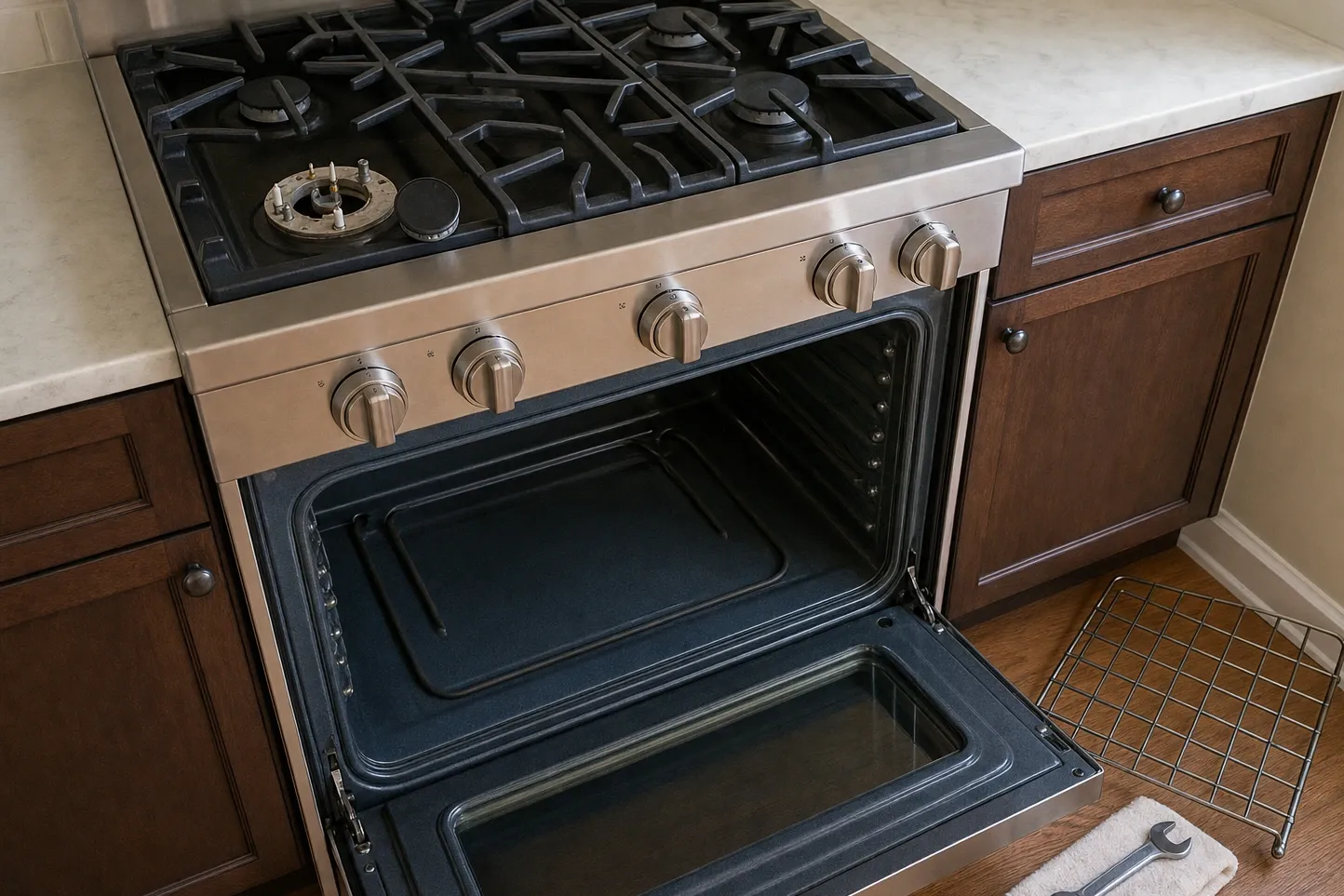
An oven that runs hot is one of the few appliance complaints where you can do most of the diagnosis yourself with a five-dollar thermometer and an hour of patience. There are three faults behind it, they behave differently, and telling them apart before anyone visits changes what gets fixed and what it costs.
What running hot usually means on a Viking cavity
A modern oven has no thermostat in the mechanical sense. A sensor — a thin metal probe in the upper rear of the cavity — changes electrical resistance as it warms. The control board reads that resistance, converts it to a temperature, compares it against what you asked for, and switches the element or the gas valve accordingly.
That chain gives you exactly three places for the error to live. The board can be told the truth and act on it with a fixed bias, which is calibration. The sensor can report the wrong number, in which case the board is acting correctly on bad information. Or the board itself can misread or mis-switch, which is the least common of the three and the one people jump to first.
The useful part is that each one leaves a different fingerprint in the numbers.
Calibration versus a drifting sensor
A calibration offset is flat. If the oven is eighteen degrees hot at 325, it will be roughly eighteen degrees hot at 375 and at 425. The error does not grow with temperature and it does not wander over a long bake. This is the benign version: most Viking ovens allow an offset to be entered, and once it is set the oven behaves correctly at every setting.
A drifting sensor is proportional, and it moves. The error grows as the cavity gets hotter — small at 300, large at 450 — because the resistance curve has shifted rather than been displaced. It may also swing during a long bake as the sensor heats through, which shows up as an oven that starts about right and is badly out forty minutes later. A sensor doing this cannot be dialled out and it is a genuinely cheap part.
A board fault is erratic. Temperatures that jump, an element that stays on after the set point is passed, a cavity that overshoots by fifty degrees then crashes, a display that lights but ignores the touch panel after a power flicker. Los Angeles gives you plenty of brownouts to trigger this last one, and it is usually a specific failed relay or a lost low-voltage supply rather than the whole board — which is worth knowing before somebody quotes you for a complete assembly.
Checking it yourself with an oven thermometer
Buy a dial or digital oven thermometer. Hang it on the centre of the middle rack, in the middle of the cavity, not against a wall.
- Set the oven to 350 and leave it. Ignore the preheat beep entirely and wait a full twenty-five minutes.
- Read the thermometer without opening the door if you can see through the glass. If you must open it, read fast and close it.
- Take a second reading ten minutes later. Note both.
- Repeat the whole thing at 450 with the same twenty-five minute settle.
- Write down four numbers: two at 350, two at 450.
Now read them. Both 350 numbers similar and both 450 numbers similar, with the same error at each — a calibration offset. Error much bigger at 450 than at 350 — the sensor. Numbers that disagree with each other at the same setting, ten minutes apart — the sensor or the board, and it needs a meter. Everything within ten degrees — the oven is fine, and what you actually have is a preheat-timing problem or an uneven cavity, which is a rack-position and door-seal conversation instead.
One more check worth thirty seconds: with the oven at temperature, run the back of your hand along the top edge of the closed door. Warmth escaping there means the seal or the springs, and that produces uneven baking that reads like a hot oven without any of the electronics being at fault.
When the board is the answer
Rarely, and it should be the last thing anyone reaches for. The honest order is: prove the sensor first, because it is the cheapest part in the chain and the most likely to have drifted; check the door and the seal, because they cost less again; then, only when the sensor measures correctly and the cavity still misbehaves, look at the board.
Where a board genuinely has failed, the repair is often narrower than it sounds. A dead cavity on one half of a double oven while the other half works normally is usually one relay, not the whole assembly. A panel that lights but ignores touch after a power event is often a lost supply rail. Both are worth diagnosing properly rather than replacing wholesale.
What we do on the visit
Eighty-nine dollars, flat, buys the drive out and the whole examination. On a temperature complaint that means the cavity is logged against our own probe through a full heat cycle rather than read once, the sensor is measured cold and hot so a drift shows up as a number instead of an opinion, the door and seal are checked, and the vent gap around the appliance is looked at — a wall oven boxed into a rebuilt cabinet run with no clearance overheats itself and trips a thermal switch partway through a roast, which is a joinery problem wearing an electrical costume.
You get told which of the three it is, and what the repair costs, before anything is replaced. Sensors and the common relays ride on the van, so most of these close on the first visit. Have the prefix off the rating plate ready when you ring — inside the door frame on a range, on the frame edge on a wall oven — and the right parts travel with the technician.
Most of what an owner can check without instruments is gathered in the yearly check-up list.
A thermostat asked to hold a surface rather than a cavity behaves differently again — see the griddle control.
Loose ends
How far adrift does an oven have to be before it spoils anything?
Roasting tolerates a lot. Baking does not. Ten to fifteen degrees shows up as edges browning before centres set, and anything past twenty-five degrees will ruin pastry and custard reliably. If cakes have started sinking and biscuits burn at the rim in a recipe you have made for years, the oven has drifted rather than your technique.
Can I just set the dial lower and live with it?
For a fixed offset, yes, and plenty of people do for years. It stops working the moment the error is not fixed — an oven that is fifteen degrees hot at 350 and forty degrees hot at 450 cannot be dialled out, because you would need a different correction at every setting. That pattern points at the sensor, not the calibration.
Why does preheat beep before the oven is actually up to temperature?
The beep follows the sensor, and the sensor sits in air near the top of the cavity while the walls and the racks are still cold. Even a healthy oven wants ten to fifteen minutes after the beep before the cavity is genuinely even. If a stone or a heavy tray is in there, give it longer.
Is a hot oven ever a door problem?
A hot oven, rarely. An uneven one, often. A tired door spring or a hardened seal lets heat escape at the top, so the sensor calls for more heat, the element runs longer, and the bottom of the cavity overshoots while the top reads correctly. If the top of your door is warm to the back of a hand, look there before the electronics.